
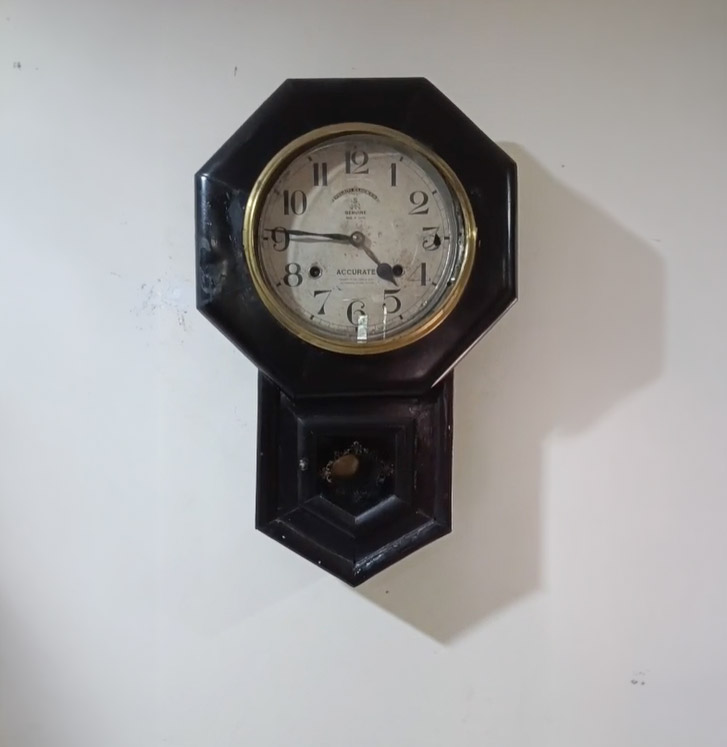
Ansonia Clock
You’ve got a charming piece there — modest, honest, and very much of its era. Let’s break it down carefully. ⸻ What the Dial Tells Us From the close-up: • Marked “GENUINE – MADE IN JAPAN” • States: “Movement of this clock is just like American Ansonia system” • Branded “ACCURATE” • Features an S.K.S. style crossed emblem That wording is important. When a clock says “like American Ansonia system,” it’s not Ansonia — it’s borrowing credibility. ⸻ About the “Ansonia System” Ansonia Clock Company was a major American clockmaker in the late 19th and early 20th centuries. Their mechanical pendulum wall clocks were exported worldwide and widely copied. Japanese manufacturers in the early–mid 20th century often patterned their movements after American designs. That line on your dial is essentially saying: “This works like a proven American movement.” It’s marketing — but historically interesting marketing. ⸻ Likely Manufacturer The crossed S.K.S. mark likely refers to S.K.S. (Shin Kanto Seisakusho or similar workshop branding) — smaller Japanese clock factories used these types of stamped initials. Many were not large global brands like: • Seikosha • Rhythm Watch Co., Ltd. Your clock does not appear to be from one of the major prestige makers. It’s more likely from a mid-tier export-oriented workshop. ⸻ Estimated Age Based on: • English export text • “Made in Japan” marking (common after export labeling laws tightened) • Styling (octagonal case, Arabic numerals, pendulum regulator) I would estimate: Most likely: Post–World War II, around 1948–1955 Why not earlier? • The typography and “ACCURATE” branding feel mid-century. • The case style aligns with early postwar reproduction of Western designs. ⸻ Construction Details • Mechanical pendulum wall clock • Likely 8-day wind movement • Key-wound (you probably wind through dial holes) • Ebonized wooden case (not true ebony — stained wood) • Brass bezel • Painted metal dial (shows age spotting) It’s a straightforward mechanical regulator patterned after American kitchen/parlor clocks. ⸻ Historical Context After WWII, Japan rebuilt its manufacturing base rapidly. Clocks were a major export category. Affordable, durable wall clocks were shipped to: • Southeast Asia • The Middle East • Parts of Europe • Occasionally North America Your clock fits squarely into that export recovery period. It represents: • Early Japanese industrial recovery • Western design influence • Mechanical clockmaking before quartz took over in the 1970s That makes it historically interesting, though not rare. ⸻ Condition Assessment (From Photos) Positives: • Original dial • Original hands • Case intact • Pendulum present Negatives: • Dial staining and spotting • Visible wear on case • No visible high-end decorative carving Condition strongly affects value. ⸻ Market Value (Realistic, Not Romantic) If fully working and complete: : It is not a high-value antique. It is collectible, but not rare or prestigious. The biggest value driver would be: • Excellent cosmetic condition • Verified working mechanical movement • Original key and pendu It’s a solid example of early mid-century Japanese export clockmaking. It tells a story about industrial rebuilding and global trade. That matters — even if auction houses don’t fight over it.
Auction History
Auction has finished
Auction failed because there were no bids| June 2, 2026 12:00 am | Auction started | ||
Vendor Information
- No ratings found yet!
Ansonia Clock
Item condition: New
Related products
-
WatchesAuction Ended


Reviews
There are no reviews yet.